



Every week, a developer in Riyadh calls us with the same story.
They hired a contractor. The contractor started making design decisions. The project manager went quiet. The budget crept up by 30%. And nobody could tell them who was actually in charge.
This is not a contractor problem. It is a role confusion problem. In Saudi Arabia’s construction industry, it is one of the most expensive mistakes a building project owner can make.
Whether you are a business owner breaking ground on a new commercial space, an investor managing a fit-out in Jeddah, or a developer in the middle of a design and construction phase, understanding the key differences between these three roles is not optional. It is the foundation of every successful build.
Let me break this down clearly.

Table of Contents
What Is the Difference?
What’s the difference between these three roles? Here is the short version:
- The Owner funds the project and holds final authority over all decisions.
- The Contractor executes the physical construction work and manages the job site.
- The Project Manager coordinates the entire project team and protects the owner’s best interests throughout.
They are not interchangeable. They do not overlap. And when one tries to do another’s job, things break down fast. Understanding project management roles from the start determines whether a project is completed on time, on budget, or becomes a cautionary story.

Who Is the Project Owner in KSA?
The owner is the entity, whether an individual, a company, or a government body, that commissions and finances the building project. In Saudi Arabia, this often means a private developer, a corporate real estate team, or a government-linked institution working under Vision 2030 guidelines.
The owner defines project goals, leads the owner team, and is ultimately the person who decides whether the overall project succeeds or fails strategically.
Key responsibilities
- Define the project vision and project goals
- Approve the total budget and construction schedule
- Select and contract the contractor and project manager
- Hold final sign-off authority on major decisions
- Represent the owner’s interests throughout the design phase and build
What owners in KSA often get wrong
Many owners step into day-to-day execution. They call subcontractors directly, change specifications mid-build, or approve payments without consulting their project manager. This feels like control. It is actually the fastest route to cost overruns and delays.
Think of the owner as the CEO of a company. The CEO sets direction and approves budgets. They do not supervise individual employees. The moment they start doing that, the whole structure collapses.
Some owners hire an owner’s representative, sometimes called an owner’s rep, to act on their behalf when they cannot be involved daily. The difference between an owner’s representative and a project manager is subtle but important: an owner’s representative and a project manager can sometimes be the same person, but the owner’s rep is specifically retained by the owner to represent their interests, while the PM manages the full project planning and delivery process.
Real insight
In high-growth Saudi markets like Riyadh’s NEOM-adjacent developments or the Red Sea Project corridors, owners are increasingly sophisticated. But in mid-market commercial fit-outs, owner interference remains the single most cited cause of schedule and budget problems among construction professionals we have spoken to.

Who Is the Contractor in KSA?
The contractor is the company responsible for physically executing building construction. They manage labor, source materials, coordinate with suppliers, and deliver the built environment against an approved design. In industry shorthand, the main contractor is often referred to as the GC, or general contractor, handling general contracting responsibilities across the full scope of work.
Construction managers work closely with the GC to keep construction activities on schedule and to the agreed standard.
Types of contractors active in Saudi Arabia
| Type | Role |
|---|---|
| Main Contractor / GC | Manages the full scope of construction work |
| Subcontractor | Handles specialized tasks under the main contractor |
| Specialized Contractor | MEP, steel, glass, or fit-out-specific construction methods |
Key responsibilities
- Procure materials and manage labor on the construction site
- Deliver work to agreed quality standards
- Maintain safety compliance under Saudi labor law
- Meet contractual milestones and manage the project schedule
- Conduct actual construction within the approved construction contract
What contractors in KSA are not responsible for
This is where confusion creates real damage. The contractor is not responsible for managing the owner’s budget expectations, for coordinating between design consultants, or for making decisions that fall outside the agreed scope.
When a contractor starts making those calls, because there is no project manager in place, you end up with construction activities delivered efficiently but not aligned with the owner’s actual project goals.
Mini case study
A corporate client in Riyadh contracted a main contractor for a 1,200 sqm office fit-out without a dedicated project manager. Midway through the construction process, the contractor had to pause for three weeks, waiting for owner’s decisions that should have been pre-approved in the design phase. The delay cost the client 85,000 SAR in extended rentals and contractor standby fees. A project manager would have front-loaded those decisions in week one, keeping the project on time and within budget.
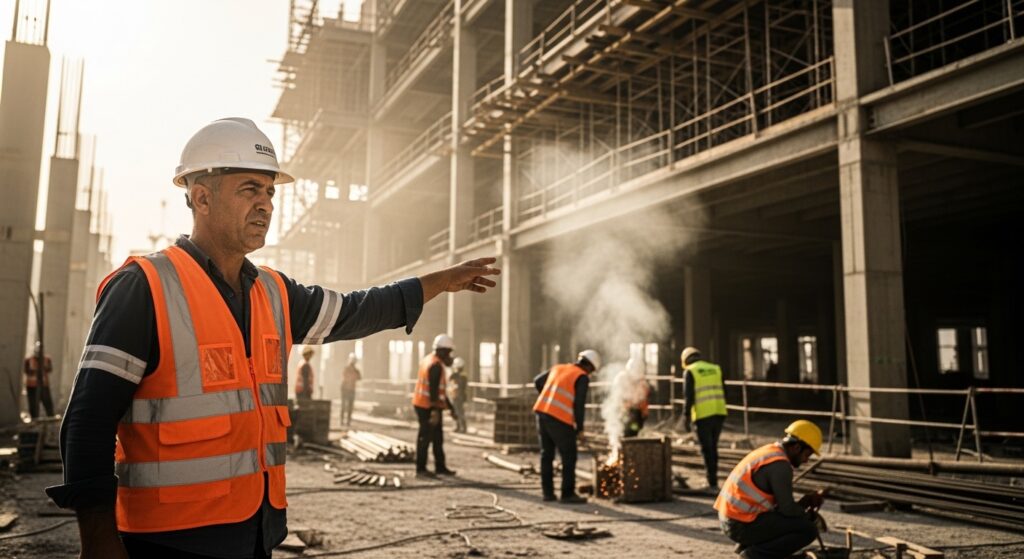
3. Who Is the Project Manager in KSA?
The project manager is the professional who sits between the owner and contractor, coordinating the full project team to keep the overall project on schedule, on budget, and aligned with the original vision. Their role is to oversee the entire project from inception to handover, acting as the central nerve of the construction management operation.
In Saudi Arabia’s complex, multi-vendor environment, this role is not a luxury. It is an operational infrastructure.
The project manager’s primary function is to manage the project so that the owner does not have to. They translate the owner’s vision into executable instructions, then oversee the construction process to ensure it matches what was agreed.
Key responsibilities:
- Develop and manage the construction schedule and project planning framework
- Monitor cost and schedule and flag deviations early, preventing cost overruns
- Coordinate between stakeholders: designers, engineers, contractors, and authorities
- Conduct risk management before issues arise on site
- Communicate clearly and consistently to ensure the project stays aligned
- Oversee quality control across every phase of the project
- Manage the construction contract on the owner’s behalf
Why the PM role is critical in KSA specifically:
Saudi Arabia’s construction industry is operating at an extraordinary scale. The Kingdom recorded over 1.25 trillion SAR in planned project value as of 2024, according to MEED Projects. In larger projects, especially multi-vendor coordination, municipal approvals, Aramco compliance requirements, and cross-cultural workforce management create a complexity level that no owner or contractor can absorb alone.
A strong construction manager vs a weak one is often the difference between a project is completed on the original timeline or running months late. The project manager is responsible for ensuring that never happens, keeping the project aligned with the owner’s expectations from the first day to the last.
The project manager is the person who holds the map when everyone else is looking at their own corner of the site.
4. Comparison Table: Owner vs Contractor vs Project Manager
| Dimension | Owner | Contractor | Project Manager |
|---|---|---|---|
| Primary focus | Investment and vision | Physical execution | Construction management and control |
| Controls the budget | Yes | Limited scope only | Monitors cost and schedule |
| Manages workers | No | Yes, directly | Oversees project team |
| Final decision authority | Yes | No | No |
| Accountable for quality | Ultimately | On construction site delivery | Audit and compliance |
| Involved daily | No, strategically | Yes | Yes |
| Hired by | Self | Owner or PM | Owner |
| Manager vs contractor | Sets direction | Executes | Coordinates |
| Construction managers work | No | Sometimes | Always |
5. How These Three Roles Work Together
Picture a triangle. The owner sits at the top. The project manager sits at the center. The contractor sits at the base.
The project team communicates through a clear hierarchy. The owner communicates through the project manager. The project manager will work to translate that vision into executable instructions for the contractor. The contractor reports project outcomes back up through the project manager, who filters and escalates only what the owner needs to act on.
Stakeholder communication is the project manager’s responsibility. In complex projects with multiple project stakeholders, this coordination function alone justifies the PM fee. When issues arise, the PM resolves them at the right level rather than escalating every decision to the owner.
When this triangle holds its shape, decisions move fast, accountability is clear, and the project stays on track.
When it collapses, and it always collapses the same way, the owner starts calling the contractor directly, the project manager’s authority disappears, and the contractor starts making decisions they were never qualified to make. The result is cost overruns, disputes, and a construction process that nobody fully controls.
6. Pricing and Cost Guidance for KSA Projects
Project management fees in Saudi Arabia typically fall within the following ranges:
| Project Type | PM Fee Range |
|---|---|
| Small building project (under 500 sqm) | 3% to 5% of project value |
| Mid-size office or retail (500-2,000 sqm) | 2.5% to 4% of project value |
| Large infrastructure or mixed-use | 1.5% to 3% of project value |
| Residential villa or private development | Fixed fee: 15,000 to 60,000 SAR |
These figures are indicative. Actual rates vary based on scope complexity, duration, and the PM firm’s experience level. For larger projects, cost estimates should include PM fees from day one, not as an afterthought.
The question owners often ask is whether the PM fee is worth it. The better question is: what does a 3-week delay cost you? In most commercial projects in Riyadh, a three-week construction schedule slippage costs more than an entire year of project management fees.

7. Common Mistakes That Derail KSA Construction Projects
1. The owner who becomes the site manager. Direct owner interference in daily construction activities creates ambiguity, slows decisions, and demoralizes the contractor. Define your role and stay in it. Let the project management structure do its job.
2. The contractor who bypasses the PM. Some contractors prefer direct owner access because it allows scope creep and variation orders to flow more freely. A strong PM prevents this. Without oversight, the project manager’s primary protection function is removed entirely.
3. No written role boundaries in the construction contract. Verbal agreements about who decides what do not survive the first budget dispute. Every building project in Saudi Arabia needs documented role definitions, decision trees, and escalation protocols built into the construction contract.
4. Hiring a PM after problems start. Project managers often prevent problems that owners do not even know are coming. Bringing one in after delays have started is like hiring a doctor after the surgery has gone wrong. Schedule management is easiest at the start of the construction process, not the middle.
5. Choosing the cheapest GC without a PM buffer. In the KSA market, low-bid contractors rely on variation orders to recover margins. Without a PM watching the scope, these variations accumulate silently. Due to labor shortages and supply chain pressures in 2025 and 2026, this risk is higher than it has ever been. The final account becomes a shock.
6. Underestimating the design phase. Many construction professionals treat the design phase as administrative. It is not. Decisions made in the design phase determine cost estimates, construction methods, and the entire project schedule. A PM involved early catches misalignments before they reach building construction.
8. Why Role Clarity Matters in Saudi Arabia Right Now
Saudi Arabia is in the middle of a construction supercycle. Vision 2030 is driving residential, hospitality, infrastructure, and commercial development at a pace the Kingdom has not seen before.
The construction industry here is attracting international capital, construction professionals from across the globe, and a regulatory environment that is evolving fast. In this context, project planning without clear role structures is a liability.
Owners and teams that establish clear boundaries from day one are completing complex projects faster, with fewer disputes, and with better project outcomes. Those who blur the lines between owner, contractor, and project manager are experiencing the compounding cost of that confusion on some of the most expensive square meters in the world.
To ensure work is delivered to the right standard, to oversee the project effectively, and to keep the project on track, every serious development in KSA needs all three roles filled by the right people.
9. Local Trust: What KSA Clients Say
“We had a contractor-only model for our first two building projects in Jeddah. Both ran over budget. When we brought in a dedicated project manager for our third project, it finished two weeks early.” , Corporate Real Estate Manager, Jeddah
“I thought the project manager was just an extra cost. I was wrong. They saved us 200,000 SAR on a single variation order by catching it before we signed. That is what real risk management looks like.” , Private Developer, Riyadh
“What I needed was someone to manage your project end to end, to translate between my vision and what the contractor actually builds. That is exactly what a good project manager does.” , Business Owner, Dammam
“We were managing multiple project sites across the Eastern Province. Without a central PM coordinating the project team, we would have lost track entirely. The construction management structure they put in place saved us months.” , Real Estate Investor, Dammam
10. FAQ: Real Questions from KSA Buyers
Can the contractor also act as the project manager?
In some small residential jobs, this happens, but it is a conflict of interest. The GC has a financial incentive to maximize scope. The project manager’s primary job is to protect the owner from unnecessary cost. These interests do not belong in the same person. This is the core construction manager vs project manager debate, and the answer is: keep them separate.
Do I need a project manager for a small fit-out in Saudi Arabia?
For building projects under 300,000 SAR, a full PM engagement may not be cost-effective. A project coordinator or a PM on a limited advisory basis can still add significant value, particularly during project planning and the design phase.
What qualifications should a project manager in KSA have?
Look for PMP certification, KSA market experience, and familiarity with MOMRA and municipality approval processes. Strong schedule management skills and a track record of delivering complex projects on time are essential. Experience in general contracting environments is a plus.
Who is legally responsible if the construction has defects?
The contractor holds primary liability for construction defects under Saudi law. The project manager is responsible for having flagged quality issues during construction activities. The owner bears responsibility for decisions made against professional advice. Clear construction contract terms protect all three parties.
How do I find a reliable project manager in Riyadh?
Ask for a portfolio of completed KSA building construction projects, check stakeholder references directly, and verify that they use a documented project management methodology. Firms like Exceptional PM specialize in this market and offer consultations to assess your specific needs.
What happens if there is no project manager on my project?
The owner absorbs the coordination burden. In practice, this means slower decisions, unmanaged risk management, and a contractor operating without adequate oversight. Most projects without a PM experience cost overruns and schedule delays. Ensuring the project stays on track without a dedicated PM is extremely difficult.
What is the difference between an owner’s representative and a project manager?
The difference between an owner’s representative and a project manager is one of focus. The owner’s representative and project manager roles overlap in many ways, but the owner’s rep is specifically retained by the owner to represent their interests in negotiations and decisions. The PM manages the full construction process from project planning to handover. On smaller projects, one person often fills both functions.
Conclusion
Understanding the difference between Owner, Contractor, and Project Manager is not a technicality. It is the architecture of a successful building project.
In Saudi Arabia’s high-investment, fast-moving construction industry, role clarity is one of the highest-value decisions you will make before a single wall goes up. The owner sets direction and project goals, the contractor handles building construction, and the project manager makes sure both happen on schedule and within budget through disciplined construction management.
If you are planning a construction process in KSA and want the right structure in place from day one, the smartest move you can make today is a conversation with an experienced team that knows this market.
Ready to build it right from day one?
Contact Exceptional PM for a free project consultation. Whether you need a full project management engagement, owner’s representative services, or a one-hour advisory call to structure your roles correctly, the team is ready to help you manage your project from start to finish.
Call or WhatsApp: +966 59 344 5125
Visit: exceptional-pm.com
Or request a free site visit for projects in Riyadh, Jeddah, and across KSA.